

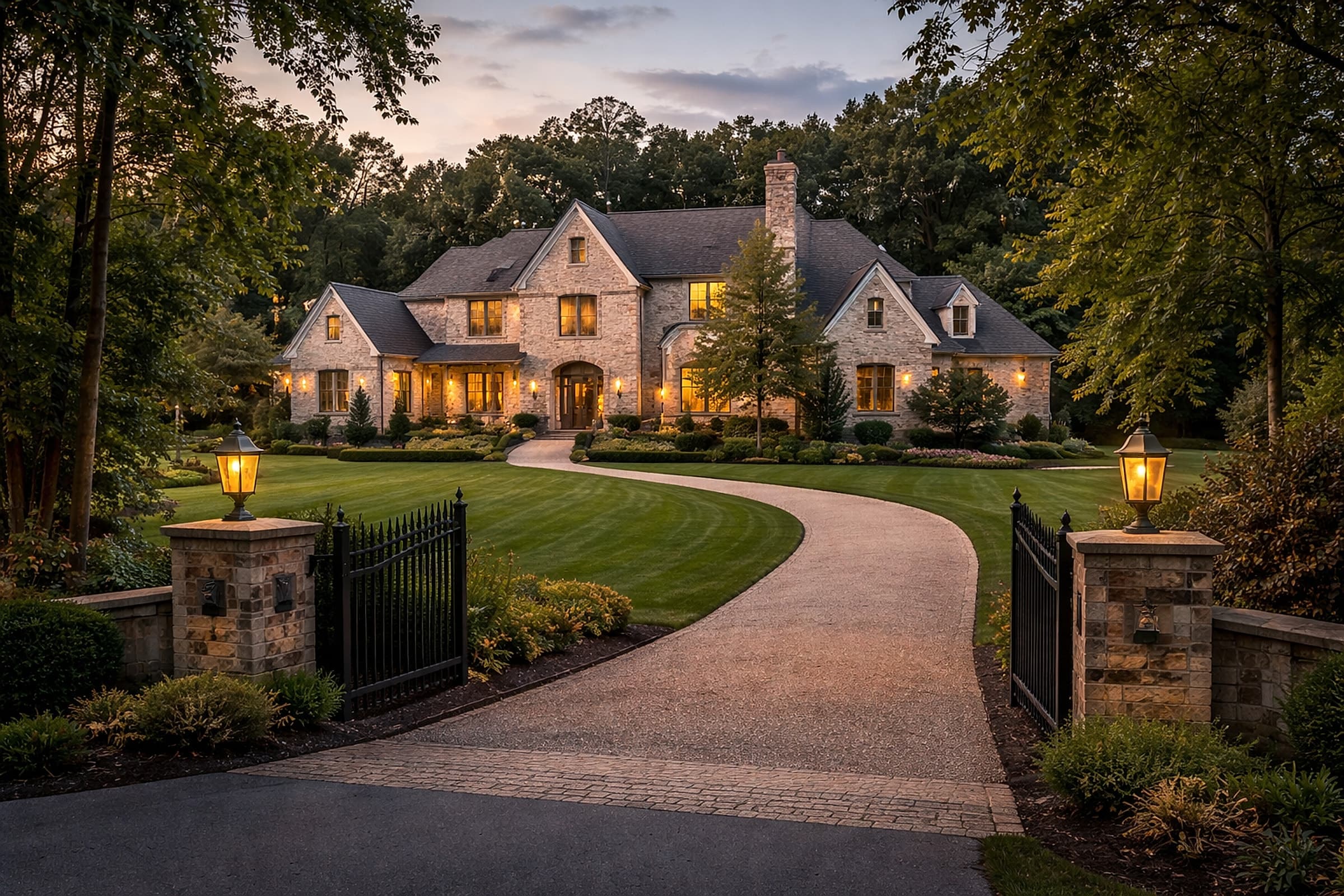
Milton Estate or Alpharetta Townhome
why they sell differently
Both command millions. Both draw discerning buyers. But from a transactional standpoint, an acreage estate and a walkable townhome operate in entirely separate ecosystems.
The North Fulton luxury landscape is defined by a striking architectural split. Within a ten-minute drive, the very definition of an elite residential asset changes completely. On one end of the corridor sits a sprawling, multi-acre estate tucked into the rolling topography of Milton. On the other, a high-specification luxury townhome steps from the chef-driven core of Downtown Alpharetta.
Both command premium, multi-million-dollar valuations. Both appeal to affluent, discerning buyers. Yet from a transactional standpoint, they operate in entirely separate ecosystems.
Treat a walkable downtown townhome and an acreage estate with the same pricing, staging, and marketing playbook, and you risk misaligning with the market on both. Here’s why these two asset classes sell differently — and how a campaign should be tailored to each.
The Buyer Pools: Opposite Motivations
To position either property well, you first have to understand who’s writing the check — and the overlap between these two buyers is nearly nonexistent, because their priorities point in opposite directions.
The Milton estate buyer is driven by space, privacy, and autonomy — often a growing family prioritizing top-tier schools (depending on the exact address, that can mean the Milton High or Cambridge High zone), or an executive seeking a quiet sanctuary. This buyer wants to look out the window and see old-growth hardwoods, a custom pool, or pasture — not a neighbor’s roofline. It’s the same instinct that drives demand in estate enclaves like The Homestead at Milton.
The Alpharetta townhome buyer is driven by connectedness, convenience, and lock-and-go mobility — frequently an affluent empty-nester downsizing from a larger legacy home, or an entrepreneur who travels constantly and doesn’t want the burden of multi-acre upkeep. This buyer wants to step out the front door and reach Little Alley Steak or the Alpharetta Farmers Market in a few minutes on foot — the walkable luxury anchored by the Avalon and Alpha Loop corridor.
Same price band, completely different dream. A campaign that speaks to one will fall flat with the other.
Pricing: Predictable Brackets vs. Uniqueness Premiums
Because the two property types are physically structured so differently, their valuations are built using different methods.
The Alpharetta townhome is a game of tight, predictable margins. In a defined community like Twelve on Canton, Maxwell, or East of Main, there are close, comparable historical data points. Value is sensitive to specific variables — an end-unit position, a private rooftop terrace, an elevator, proximity to the main walkable strip. Because savvy buyer agents track the neighborhood grid closely, mispricing by even a small margin shows up immediately.
The Milton estate requires a more complex, non-linear approach. Traditional comps strain because no two parcels are alike — one property might offer a multi-acre buffer with private trail access, another three acres with dramatic elevation changes. Pricing has to value the land volume, the architectural pedigree, and the cost of ultra-luxury outdoor improvements (detached guest houses, custom masonry, smart-home systems) somewhat independently. It’s hands-on analysis, not a formula — which is exactly why an estate seller is poorly served by an automated number. (More on that in how to price a luxury home for the right buyer.)
Two assets, two campaigns —
never one generic playbook
Whether you’re divesting a multi-acre Milton compound or positioning a lock-and-go downtown residence, the strategy has to be built for the property. It starts with a senior-agent read of your home.
Presentation: The Urban Vibe vs. The Country Narrative
The marketing media has to match the emotional expectation of the target buyer.
The townhome is about sleek efficiency, premium materials, and vertical flow. Photography and video should emphasize high-end finishes, integrated appliances, and seamless transitions onto private patios or balconies — and, crucially, the surrounding lifestyle. For a downtown townhome, the neighborhood isthe primary amenity: footage of the active historic district matters as much as the interior shots. (It’s the same walkable-luxury thesis explored in the new luxury suburbanism.)
The estateis about scale, horizon lines, and privacy. Standard wide-angle interiors don’t do a custom estate justice; the campaign wants architectural twilight photography and drone work that maps the acreage and the buffers. The story isn’t walkability — it’s the experience of arriving down a long private drive, the sprawling primary wing, the secluded outdoor living. Different vocabulary entirely.
The campaign has to be built for the asset.
A broad-market agent who mostly handles production housing tends to view both properties through one generic lens. A luxury specialist understands that selling a piece of Milton’s historic horse country takes a completely different vocabulary than selling an elite townhome on the Alpha Loop — different buyers, different pricing logic, different media, different story.
Whether you’re divesting a multi-acre compound or positioning a premium lock-and-go downtown residence, the campaign has to be built for the asset. That starts with an agent who knows both ends of this corridor cold — from selling in Milton to selling in Alpharetta.
Let’s position your home precisely.
Estate or townhome, the right campaign starts with a senior-agent read of your property, your buyer, and your market. No cost, no obligation. Jeni follows up personally.
Discreet · No spam · Jeni follows up personally